City Brain Challenge
In this challenge, we will provide you with a city-scale road network and its traffic demand derived from real traffic data. You will be in charge of coordinating the traffic signals to maximize number of vehicles served while maintaining an acceptable delay. We will increase the traffic demand and see whether your coordination model can still survive.
Problem
Traffic signals coordinate the traffic movements at the intersection and a smart traffic signal coordination algorithm is the key to transportation efficiency. For a four-leg intersection (see figure below), 1 of 8 types of signal phases can be selected each period of time step, serving a pair of non-conflict traffic movements (e.g., phase-1 gives right-of-way for left-turn traffic from northern and southern approaches). In this competition, participants need to develop a model to select traffic signal phases at intersections of a road network to improve road network traffic performance.
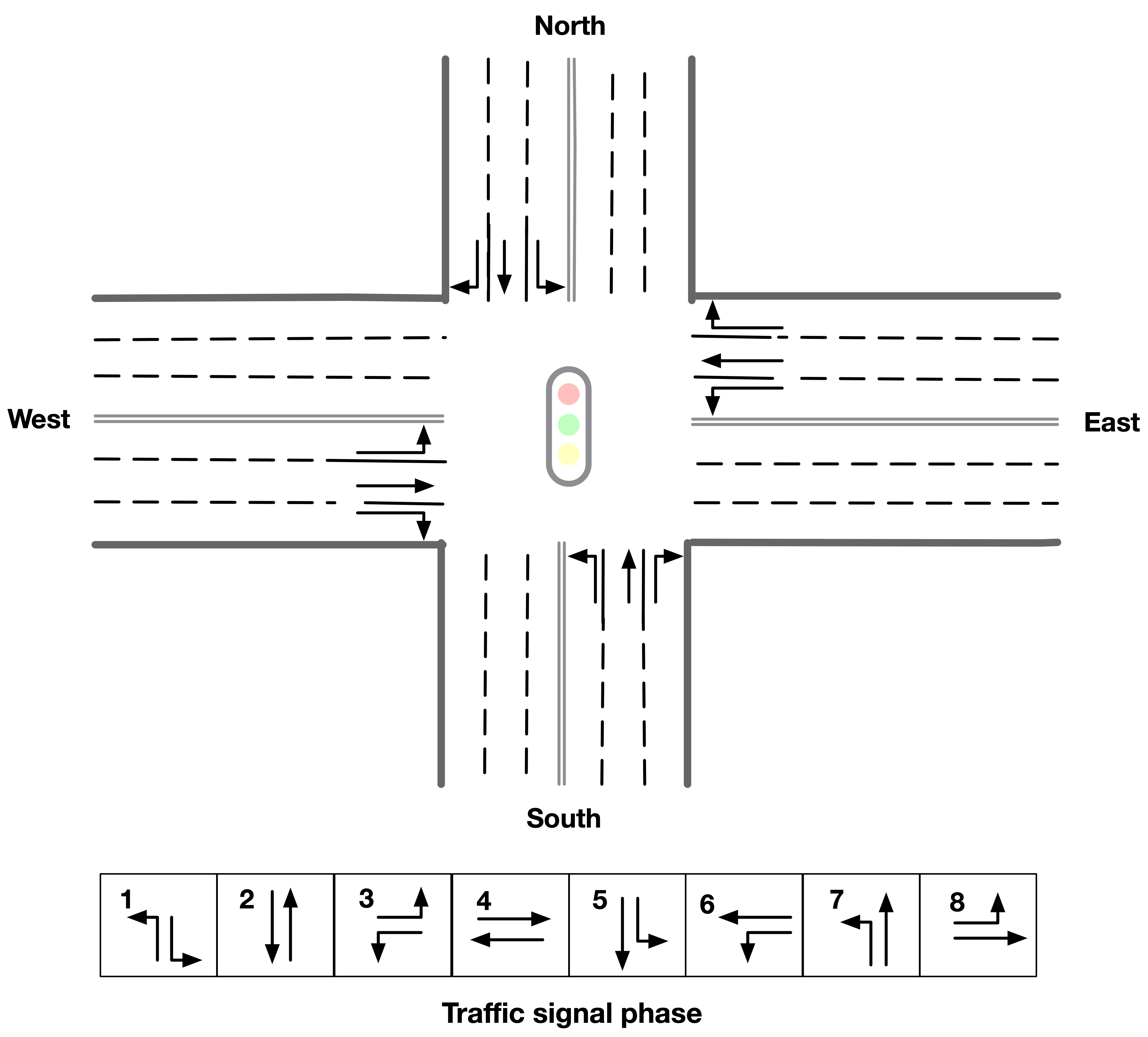
In the qualification round, a city-scale road network and 1-hour traffic data is provided. We use exactly the same road network and traffic data for scoring your submissions. The traffic demand changes every 20-minute: during the first 20-minute, there are about a total of 33,000 vehicles entered the road network, this number increases to 40,000 and 47,000 for the next two 20-minutes.
Evaluation
Total number of vehicles served (i.e., total number of vehicles entering the network) and delay index will be computed every 200 seconds to evaluate your submissions. The evaluation process will be terminated once the delay index reaches the predefined threshold 1.60. We carefully tuned the delay threshold to ensure that lower bound of level of service can be met if the solution is implemented in a real city. The submission scoring and ranking process follows three principles:
Solutions that served more vehicles will rank higher.
If two solutions served the same number of vehicles, the one with lower delay index will rank higher.
If two solutions served the same number of vehicles with same delay index, the one submitted earlier will rank higher.
The trip delay index is computed as actual travel time divided by travel time at free-flow speed. For an uncompleted trip, the free-flow speed is used to estimate the travel time of rest of the trip. The delay index is computed as average trip delay index over all vehicles served: \(D = \frac{1}{N}\sum_{i=1}^{N}{D_{i}}\).
- The trip delay \(D_{i}\) of vehicle \(i\) is defined as \(D_{i} = \frac{TT_{i} + TT_{i}^{r}}{TT_{i}^{f}}\), where,
\(TT_i\): travel time of vehicle \(i\);
\(TT_{i}^{r}\): rest of trip travel time, estimated with free-flow speed;
\(TT_{i}^{f}\): full trip travel time at free-flow speed
Code
Participant will get a starter-kit. It contains:
# Participants must implement
agent/agent.py

# Participants could modify
agent/gym_cfg.py
cfg/simulator.cfg

# A simple demo of the environment
demo.py

# Scoring and simulation program
evaluate.py

# Other files and directory
data/flow_1x1_txt
data/flow_warm_up_1000.txt
data/flow_round2.txt
data/roadnet_1x1.txt
data/roadnet_warm_up.txt
data/roadnet_round2.txt
agent/agent_DQN.py
train_dqn_example.py
log/
out/
Participants should implement their algorithm in agent.py. And then execute evaluate.py to get scores. Participants could modify simulator.cfg and gym_cfg.py.